A management team opens its customer dashboard. The latest score has improved. The presentation is encouraging, yet the meeting ends with the same unresolved question: where should the business invest next?
There is no necessary contradiction. A score describes something that was measured. An investment decision asks the organization to choose between alternatives, under constraints, with consequences it cannot know in advance. Connecting the two requires work that a favorable number cannot do on its own.
The temptation is to move directly from the observation to a preferred action. Better feedback becomes an argument for expanding a programme. Weaker feedback becomes a reason to redesign an experience. Sometimes those responses are appropriate. The score itself, however, has not yet established which response deserves resources.
The missing decision
Customer measures often arrive in a meeting before the decision has been clearly stated. The discussion begins with whether the number is good, how it compares with the previous period and what narrative might explain it. These can be useful questions, but they do not necessarily identify the choice management is responsible for making.
A more useful starting point is concrete: are we deciding which experience improvement to fund, which customer issue to investigate, or how to assess a proposed commercial change? Each question places different demands on the evidence. The same movement in a score cannot answer all three.
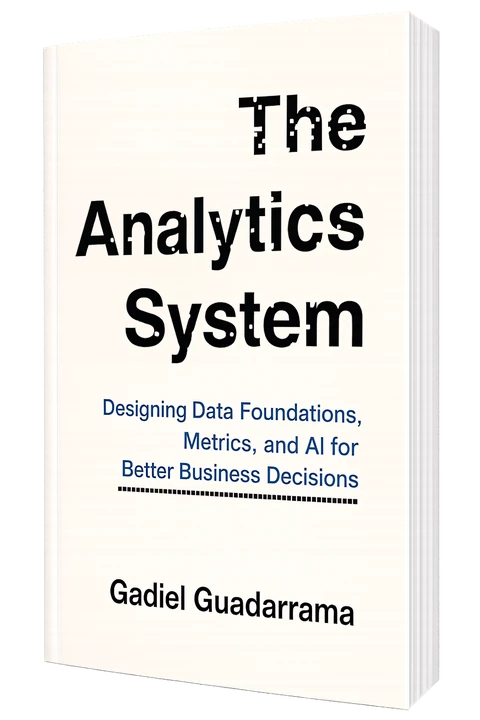
In The Analytics System, Customer Love Quotient brings customer attachment into a broader architecture of business decisions. That perspective matters because attachment, observed behavior and commercial value need to be connected thoughtfully. None should silently stand in for the others.
The investment question
Consider a retail business choosing between improving service reliability and adding a new customer benefit. Both proposals can be presented as customer-centred. Both can attract persuasive stories. If resources are constrained, management still needs to choose.
An aggregate score offers limited help unless the discussion preserves the relationship between the evidence and the alternatives. Which customers encounter the reliability problem? What suggests the new benefit addresses something important? Are the operational demands understood? What would the business give up by choosing either option?
This is where customer evidence can contribute without carrying more weight than it can support. It can sharpen the question, challenge assumptions and identify what needs closer investigation. It does not remove the need to consider feasibility, cost and opportunity cost.
There is also a useful distinction between correcting a failure and creating a new reason for preference. Both can matter, but they are different propositions. A management discussion becomes clearer when the team names the proposition before interpreting the customer measure as support for it.
When signals diverge
Now imagine a subscription business in which survey responses improve while repeat purchasing weakens. The apparent disagreement invites a quick explanation: perhaps customers express affection but will not pay, or perhaps a recent change has harmed retention.
Those explanations may deserve consideration. Before selecting one, the team needs to understand whether the signals are comparable. Do they describe similar customers? Do their time periods line up meaningfully? Has the mix of respondents or purchasers changed? What does each source actually observe?
The divergence is a reason to investigate. It is not proof that the customer measure has failed, and it does not establish that the preferred commercial explanation is correct. Treating the disagreement as a question can be more productive than forcing the evidence into a single reassuring story.
A team may discover a practical issue with comparability. It may find that different groups are behaving differently, or that conditions outside the measured relationship matter more to the choice under consideration. Until that work is done, stronger reported attachment should not be read as a guarantee of renewal or repeat purchase.
Commercial trade-offs remain commercial
A third situation arises when a consumer brand considers a change in pricing or promotion. Customer attachment is relevant to the discussion, but it cannot replace an understanding of affordability, alternatives, purchasing behavior and the economics of the change.
It would be convenient to treat a favorable relationship measure as permission to increase price. That inference asks more of the evidence than the score alone can establish. It confuses a description of attachment with a conclusion about how customers will respond to a specific commercial intervention.
The more useful contribution is disciplined questioning. Which assumptions about the relationship are embedded in the proposal? What other evidence supports those assumptions? Where could the decision have different consequences for different customers? What would the team want to observe after acting?
These questions keep the discussion connected to the choice management faces. They also preserve room for uncertainty. A responsible decision can be made with incomplete evidence, provided the limits are understood and the organization is clear about what it is choosing to learn.
Three questions to take into the meeting
- What choice does this evidence need to inform? State the alternatives clearly enough that a change in the evidence could affect the discussion.
- What can the evidence support in this context? Distinguish a useful signal, an interpretation and a claim about the consequences of an intervention.
- What remains a matter of managerial judgment? Name the trade-offs, uncertainty and responsibility that the measure cannot absorb.
These are executive questions rather than a substitute for the full CLQ framework. Their purpose is to keep a customer conversation connected to a commercial decision. They are also a reminder that an organization can become better at measuring customers without automatically becoming better at deciding what to do.
A score begins the conversation
The aim is not to make customer measures carry the whole burden of management. It is to give them a useful place within it. A score can raise a question, challenge a comfortable assumption or reveal a movement that deserves attention. The organization still has to decide how that evidence relates to the alternatives before it.
Customer love becomes commercially interesting when it is examined alongside the choices a business makes. The quality of that connection deserves as much attention as the direction of the score.
Further reading
This essay is a complementary management perspective. Customer Love Quotient, as developed by Gadiel Guadarrama, is presented in The Analytics System. The scenarios above are illustrative and make no claim of measured client results or empirical validation.
Explore the book