
Commercial applications
Begin with the choice.
Then examine the evidence.
Three illustrative situations in which customer attachment can contribute to a more useful commercial discussion.
These scenarios are illustrative. They do not describe client engagements, measured outcomes or validated CLQ benchmarks.
01 / Experience investment
Improve availability
or add a new benefit?
The choice: where to commit the next increment of resources.
A retail team is considering two proposals: make an existing service more reliable, or introduce an additional benefit. Both are described as ways to improve customer experience. The proposals compete for the same resources.
What deserves attention
The discussion needs more than a favorable aggregate score. Which customer groups experience the current problem? How does the evidence relate to the proposed change? Are the alternatives feasible, and what would each require the organization to stop doing?
Where the CLQ perspective contributes
Customer attachment becomes part of an investment discussion, alongside operational evidence, cost and commercial context. The aim is to clarify what the evidence supports before committing to a response.
A plausible relationship is a reason to investigate, not a guarantee that a proposed investment will pay back.
02 / Retention & value
Feedback improves.
Repeat purchasing falls.
The choice: what to investigate before changing the retention strategy.
A subscription business sees stronger survey responses while repeat purchasing weakens. One team wants to increase loyalty rewards. Another argues that pricing is the issue. A third points to a change in the customer mix.
What deserves attention
Do the signals describe comparable customers and periods? Are reported attitudes being read alongside behavior, or treated as a substitute for it? What other explanation could account for the divergence?
Where the CLQ perspective contributes
The gap between attachment and observed behavior becomes the subject of the discussion. Customer evidence helps formulate questions; commercial and transactional evidence are needed to investigate them.
The scenario does not assume that attachment explains every renewal or purchasing decision. It does not establish a predictive relationship.
03 / Brand & revenue
Protect the relationship.
Understand the trade-off.
The choice: how to assess a proposed change in pricing or promotion.
A consumer brand considers adjusting its price and promotional approach. Its commercial team wants to understand the customer implications alongside margin, affordability and competitive alternatives.
What deserves attention
Which assumptions about customer attachment are being made? What purchasing evidence supports them? How might the proposed change affect different customer groups, and what other market conditions could influence the result?
Where the CLQ perspective contributes
Customer relationships have a place in the discussion without replacing the economics of the decision. The connection to revenue growth management is a question of judgment, evidence and trade-offs.
Reported attachment should not be interpreted as permission to increase prices or as proof of willingness to pay.
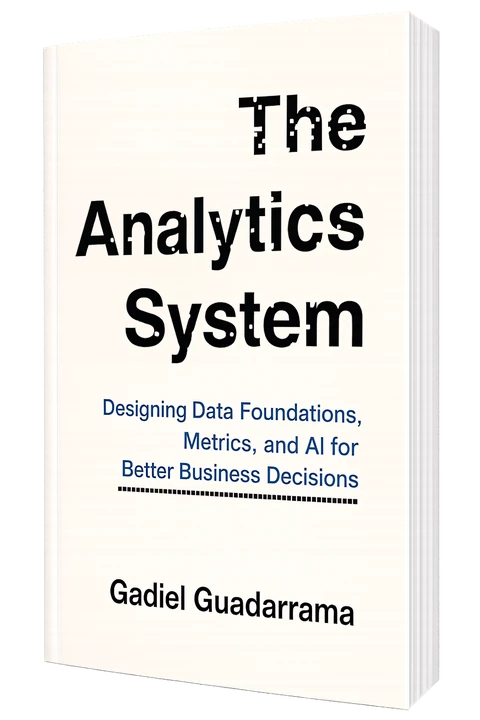
The source of the framework · Now published
One framework.
A larger architecture.
The Analytics System explores how data foundations, metrics, AI and managerial judgment connect. Customer Love Quotient is one contribution within that architecture.
The book provides the full conceptual treatment. This site extends the discussion through selected commercial applications.
Amazon US · English first edition · Published October 20, 2026.
Retailer pricing, availability and delivery apply.
Advisory through Gadiel Analytics
A specific decision
is a good place to start.
If customer evidence is raising questions about investment, retention or commercial priorities, start with the decision your organization needs to make.
Discuss an application